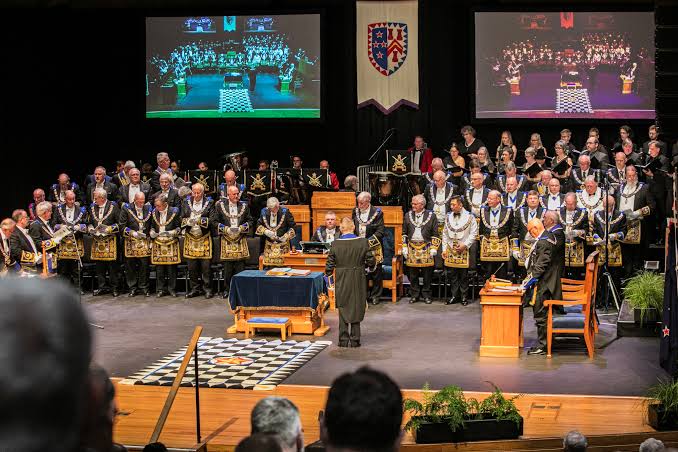
For someone who has never attended a Masonic meeting, a closed lodge-room door can invite all kinds of speculation. The reality is usually much more straightforward. A lodge meeting combines the formal business of an organisation, traditional ceremony, learning, friendship and time set aside for members to support one another.
At Lodge Tawhiri No. 166 in Hamilton, as in lodges throughout New Zealand, the evening has a clear structure. Some details of Masonic ceremony are kept private, but the general shape of a meeting is not difficult to explain.
Before the meeting begins
Members arrive before the stated starting time. There is usually a good deal of ordinary conversation while men greet one another, welcome visitors and prepare for the evening.
Members change into the dress and regalia appropriate to the meeting. Officers check that the lodge room is ready and make sure they understand their parts. The Secretary may deal with correspondence or last-minute apologies. A newer member might quietly go over a piece of ritual with a more experienced Brother.
This preparation is practical, but it also helps mark a change of pace. Members come from different jobs, families and responsibilities. Once the meeting begins, everyone is expected to give it his attention.
The formal opening
A Masonic lodge is opened according to an established form. The Master presides, supported by officers who each have particular duties. The wording and movements are traditional, and the atmosphere is orderly rather than casual.
This formality is part of what makes a lodge meeting different from a committee meeting or social club gathering. Members are reminded that they are taking part in something shared with Freemasons across New Zealand and in many other parts of the world.
The opening is not performed for spectacle. Its purpose is to bring the lodge together, establish the meeting properly and create a setting in which the work of the evening can be carried out with care.
The business of the lodge
Like any well-run organisation, a lodge has ordinary business to conduct. Minutes may be confirmed, correspondence received, accounts considered and plans discussed.
Members may hear reports about charity projects, social events, visits to other lodges, the welfare of members, building matters or future meetings. Membership matters are handled carefully and confidentially. Decisions are made according to the lodge’s rules and the constitution under which it operates.
At Lodge Tawhiri, much of the detailed administration is considered at a separate business meeting. This allows the regular lodge meeting to give proper attention to ceremonial work, education and fellowship.
Ceremony and symbolism
Ceremony is the part of Freemasonry that tends to attract the most curiosity. Freemasons New Zealand describes Masonic ceremonies as formal and symbolic presentations that use drama to communicate principles and standards of conduct.
The three main Craft ceremonies mark a member’s progress through the degrees of Entered Apprentice, Fellowcraft and Master Mason. They use allegory, traditional language and symbols drawn largely from the tools and work of stonemasons.
They are not stage performances for an audience. They are intended to make moral ideas memorable. Themes include honesty, responsibility, self-discipline, service, mortality and the proper use of a person’s time and abilities.
The private parts of the ceremony are not published by the lodge. This is partly a matter of keeping a promise of confidentiality and partly to preserve the experience for future candidates. Their purpose is instruction and reflection, not embarrassment or spectacle.
Learning by taking part
A lodge meeting is not something members simply watch. Men gradually learn portions of ritual, assist with ceremonies, give short talks, present research or take responsibility for an office.
This participation develops confidence, memory, public speaking and the ability to work with others. It also teaches patience. Few members perform every part perfectly, and improvement usually comes through practice, encouragement and experience.
Older or more experienced members help newer Brethren understand the customs of the lodge. That support matters. Freemasonry has a great deal of tradition, and it is easier to learn when someone is willing to explain what is expected without making a new member feel foolish.
Why are the doors closed?
The doors are closed because a formal lodge meeting is for Freemasons. That does not mean that everything discussed inside is secret.
Freemasonry is not a religion. Under Freemasons New Zealand, political and sectarian religious debate is kept out of lodge meetings. The lodge brings together men who may hold very different personal views, while asking them to meet on common ground.
Privacy also allows members to discuss personal welfare and membership matters responsibly. Most community organisations have parts of their work that are limited to members. Freemasonry is more formal about that boundary because confidentiality is one of the lessons it expects members to practise.
After the lodge closes
The formal meeting ends with a closing ceremony. Members remove their regalia and usually move to the refectory for a meal or supper.
This is often the most relaxed part of the evening. There may be toasts, notices and a short response from a visitor, but there is also plenty of ordinary conversation. Members catch up, welcome guests and get to know people they may not otherwise have met.
For many Freemasons, the value of lodge life is found in this balance. The ceremony gives the evening structure and meaning. The refectory gives friendships room to grow.
Can a non-Mason visit?
A non-Mason cannot normally attend the formal lodge meeting, but that does not prevent him from getting a genuine sense of the lodge.
A man interested in joining Freemasonry can meet members informally, ask direct questions and, where arranged, attend the refectory as a guest. Lodge Tawhiri also holds social activities where partners, families and friends may be involved.
There is no expectation that an enquiry must lead to an application. It is sensible to take time, speak with members and decide whether the commitments and character of Freemasonry are right for you.
What happens behind the lodge doors is neither as mysterious nor as ordinary as some imagine. It is a structured evening in which men conduct their responsibilities, take part in ceremony, learn, support charitable work and spend time in one another’s company.
For men in Hamilton or the wider Waikato who would like to learn more, the best next step is simply to make an enquiry and have a conversation with a local member.