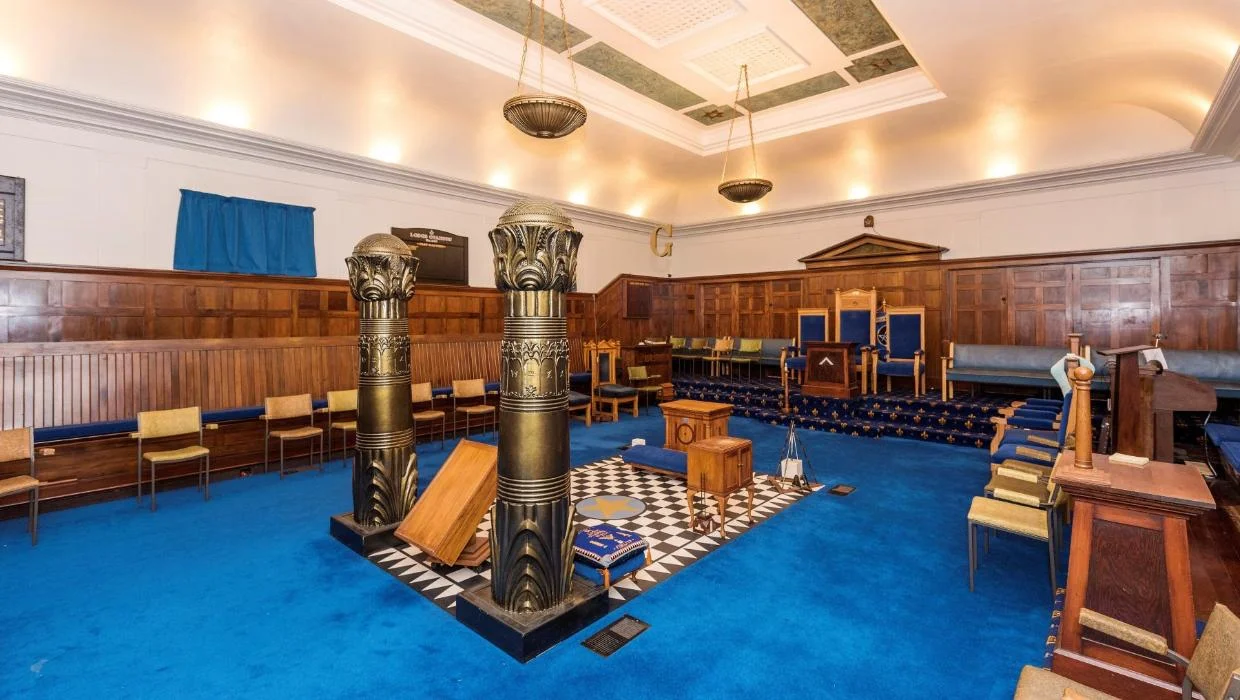
Freemasonry has attracted curiosity for generations.
People notice the aprons, collars, symbols and unfamiliar titles. They hear that parts of Masonic ceremonies are private. They may know that a relative, neighbour or well-known public figure was a member while knowing little about what membership actually involved.
It is not surprising that questions follow.
It looks different from an ordinary club
A Masonic lodge does not look quite like a sports club, service organisation or workplace meeting.
The room is arranged for a particular purpose. Officers have traditional titles such as Master, Warden, Deacon and Tyler. Members wear regalia during formal meetings, and ceremonies use symbols and language passed down through generations.
Most of this is not secret.
Photographs of lodge rooms and regalia are widely available. The general structure, principles and activities of Freemasonry can be explained publicly.
It is still unfamiliar to many people. When something looks old, formal and different, people naturally want to know more about it.
A long history leaves room for stories
Freemasonry has existed in organised form for more than three centuries, with some of its customs and imagery reaching further back.
During that time, Freemasons have included men from many occupations and parts of public life. Lodge buildings, symbols and records have survived in communities around the world.
A long history gives people plenty to discuss, but it also creates room for myths to develop.
Real events become mixed with novels, films, internet claims and stories repeated without evidence. Freemasonry is then presented as either far more powerful or far more unusual than it is.
The ordinary life of a Lodge is less dramatic.
Members conduct Lodge business, take part in ceremonies, listen to educational presentations, organise charitable work and spend time together after meetings.
Why are parts of the ceremonies private?
Freemasons do not publish every detail of their ceremonies.
The main reason is not that the purpose of the organisation needs to be concealed. The private elements form part of the experience through which a new member is introduced to Freemasonry.
Knowing every word and movement beforehand would change that experience.
Keeping certain details private also asks members to show that they can be trusted with a confidence. That principle is less about hiding information from the public and more about the value placed on trust between members.
This is different from hiding what Freemasonry believes or does.
Its principles, membership requirements, charitable activities and organisational structure are public. A prospective member can ask about the time involved, the cost, the expectations of membership and what normally happens during a Lodge evening before deciding whether to apply.
The distinction is between private ceremonies and a hidden purpose. Freemasonry in New Zealand does not conceal its existence, its buildings or its general activities.
What Freemasonry is not
Curiosity has sometimes led to Freemasonry being described as a religion, political organisation or private business network.
Freemasonry is not a religion and does not replace a member’s faith. Members must believe in a Supreme Being, but Freemasonry does not instruct them how to worship.
Religious and political disputes are not permitted during Lodge meetings. This is intended to prevent matters that can divide members from becoming part of the Lodge’s work.
Membership should not be sought for business, influence or personal advantage.
Meeting men from different occupations naturally creates friendships, but those relationships do not entitle a member to expect special treatment.
These boundaries are less exciting than many public theories, but they provide a more accurate picture of ordinary Lodge life.
Curiosity can be a beginning
Many Freemasons began by asking questions.
They may have known a member, passed a Masonic building or encountered a symbol they did not understand. Curiosity encouraged them to read further and eventually speak with a local Lodge.
There is nothing wrong with that.
The important distinction is between curiosity as a beginning and joining merely to discover private details. Membership involves time, participation and responsibilities towards other members and the Lodge.
That is why an enquiry normally begins with an informal conversation rather than an immediate application.
A prospective member can ask questions and get to know some of the men involved. Lodge members can also explain honestly what membership requires.
There is no obligation to continue if it does not appear suitable.
Asking is better than guessing
Lodge Tawhiri No. 166 has been part of Hamilton since 1909. Its members are local men of different ages, occupations and backgrounds.
A normal month includes a formal Lodge meeting, a separate business meeting and time together in the refectory. Members also visit other lodges, take part in educational activities and support charitable projects.
Some ceremonial details remain private, but the purpose and character of the Lodge do not need to be hidden.
Anyone with a genuine question is welcome to read the Lodge’s public information or make an informal enquiry.
Asking directly will usually provide a better answer than relying on rumours or online theories.