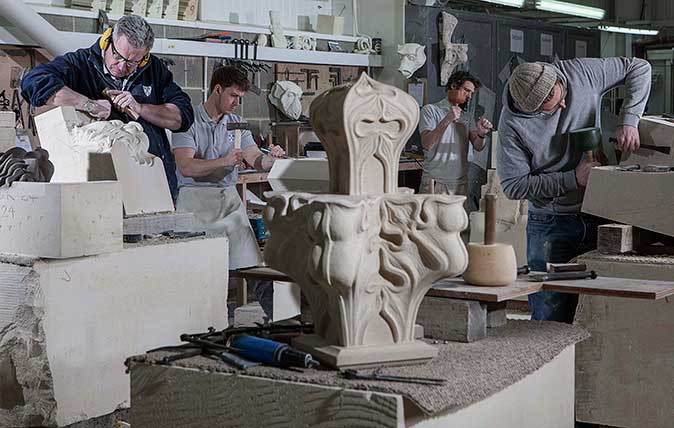
Freemasonry regularly borrows the tools and language of builders.
Its ceremonies speak of foundations, plans, measurements and the shaping of stone. Lodge officers wear emblems drawn from the building trade, and Freemasonry itself is often referred to simply as the Craft.
This does not mean that modern Freemasons imagine themselves to be medieval stonemasons.
The builders remain important because their work offers a practical way of thinking about conduct. Their materials had to be prepared carefully, their measurements had to be accurate, and the finished work had to be strong enough to serve its purpose.
It was not enough for a building merely to look impressive. It had to be sound.
Work must be tested
Building provides a useful comparison because the quality of the work can be examined.
A wall is upright or it is not. A surface is level or it is not. Measurements must agree with the plan, and the foundations must carry the weight placed upon them.
A mistake may remain hidden for a time, but weakness eventually shows itself.
Human conduct cannot be measured as neatly as stonework. Even so, the comparison encourages a Freemason to examine what he is doing rather than simply assume that it is right.
Are his words consistent with his actions? Can other people depend upon him? Has he carried out a responsibility properly, or merely done enough to appear busy?
The working tools do not answer those questions for him. They serve as reminders that good intentions are not always enough.
The work still has to meet a standard.
Foundations come before appearance
The most noticeable parts of a building are seldom the parts upon which it depends most.
Before the walls rise, the site must be prepared. The plans must be understood, the materials selected and the foundations laid properly.
Much of this work will eventually be hidden, but the whole structure depends upon it.
The same distinction can be made between reputation and character.
Reputation is what other people believe about someone. Character is formed through ordinary decisions, habits and responsibilities, many of which attract little attention.
A man may appear successful while neglecting his family, failing to keep his word or avoiding obligations that others quietly carry on his behalf.
The language of building reminds Freemasons that appearance cannot permanently compensate for weak foundations.
Why ordinary tools became Masonic symbols
Most Masonic symbols begin with something practical.
The square is used to test whether an angle is correct. It therefore provides a natural image of fairness, accuracy and proper conduct.
The level establishes a true horizontal line and reminds members that they meet within the Lodge as equals.
The plumb rule tests whether work stands upright. Its connection with upright conduct is straightforward.
The compasses establish boundaries and proportions, making them an appropriate emblem of restraint and proper limits.
These tools are not regarded as magical objects. Their meaning comes from the work they were designed to perform.
A builder uses a tool to check his work rather than trusting his eye alone. In much the same way, a Freemason is encouraged to examine his conduct rather than relying entirely upon his own favourable opinion of it.
Rough stone and gradual improvement
A stone taken from the quarry is not necessarily ready to take its place in a finished building.
It may have to be measured, shaped and smoothed before it can be used.
Freemasonry has long used this as an image of personal improvement.
The comparison does not suggest that men should become identical, nor that anyone can make himself flawless. It acknowledges something much more ordinary.
Everyone has faults, habits and rough edges that require attention.
Meaningful improvement usually happens gradually. It comes through repeated decisions, honest correction and the willingness to keep working when there is no immediate recognition.
The image also contains a warning. Stone removed carelessly cannot simply be replaced. Effort must therefore be accompanied by patience, judgement and restraint.
Change is not valuable merely because it is dramatic. It must also be wise.
No sound building is the work of one man
Important buildings require planning, different skills and the work of many people.
Some tasks are prominent and easily recognised. Others are completed quietly and may never be noticed by those who later use the building.
Both are necessary.
A Lodge works in much the same way.
The Master presides, but a successful meeting also depends upon the Wardens, Secretary, Treasurer, Director of Ceremonies, Deacons, Almoner, Stewards and many others.
Someone prepares the room. Someone checks the records. Someone welcomes a visitor, contacts an absent member or helps organise the refectory.
Some duties are carried out in full view of the Lodge. Others are completed before anyone arrives or after everyone else has gone home.
The builders offer a useful reminder that work does not become unimportant simply because few people notice it.
Tradition must continue to mean something
Freemasonry has retained the imagery of builders for generations.
That continuity is valuable, but tradition should not be preserved without thought.
A symbol is useful only while members continue to consider what it means and how it might apply to the responsibilities they actually face.
Looking back to the builders does not require a Lodge to resist every change.
Builders themselves had to understand their materials, surroundings and purpose. They adapted their methods when necessary while maintaining the standards required to produce sound work.
A Lodge has a similar responsibility.
Its customs connect present members with those who came before them, but each generation must apply their lessons within the community and circumstances it knows.
The builders in a Hamilton Lodge
Lodge Tawhiri No. 166 was constituted in Frankton in 1909.
Many of its early members were connected with the railway and the practical development of the district. The Lodge today includes men from a much wider range of occupations.
Few are working stonemasons, but the square, level, plumb rule and other tools of the builders remain familiar within the Lodge room.
They are not displayed simply because they are old.
They remind members to prepare carefully, test their own work, support the men working beside them and carry their responsibilities properly.
The tools have been passed down through generations of Freemasons.
Whether their lessons are put to practical use is the responsibility of each member.